The Site
What it looks like
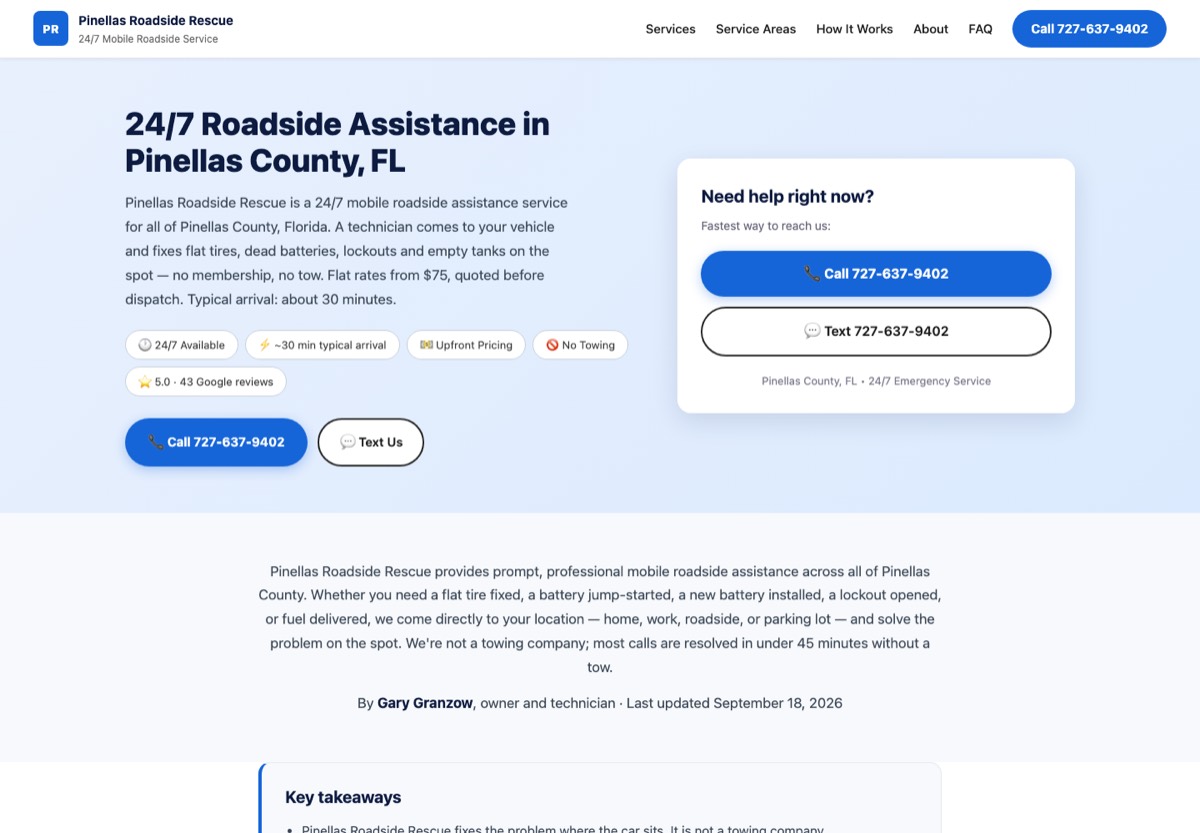
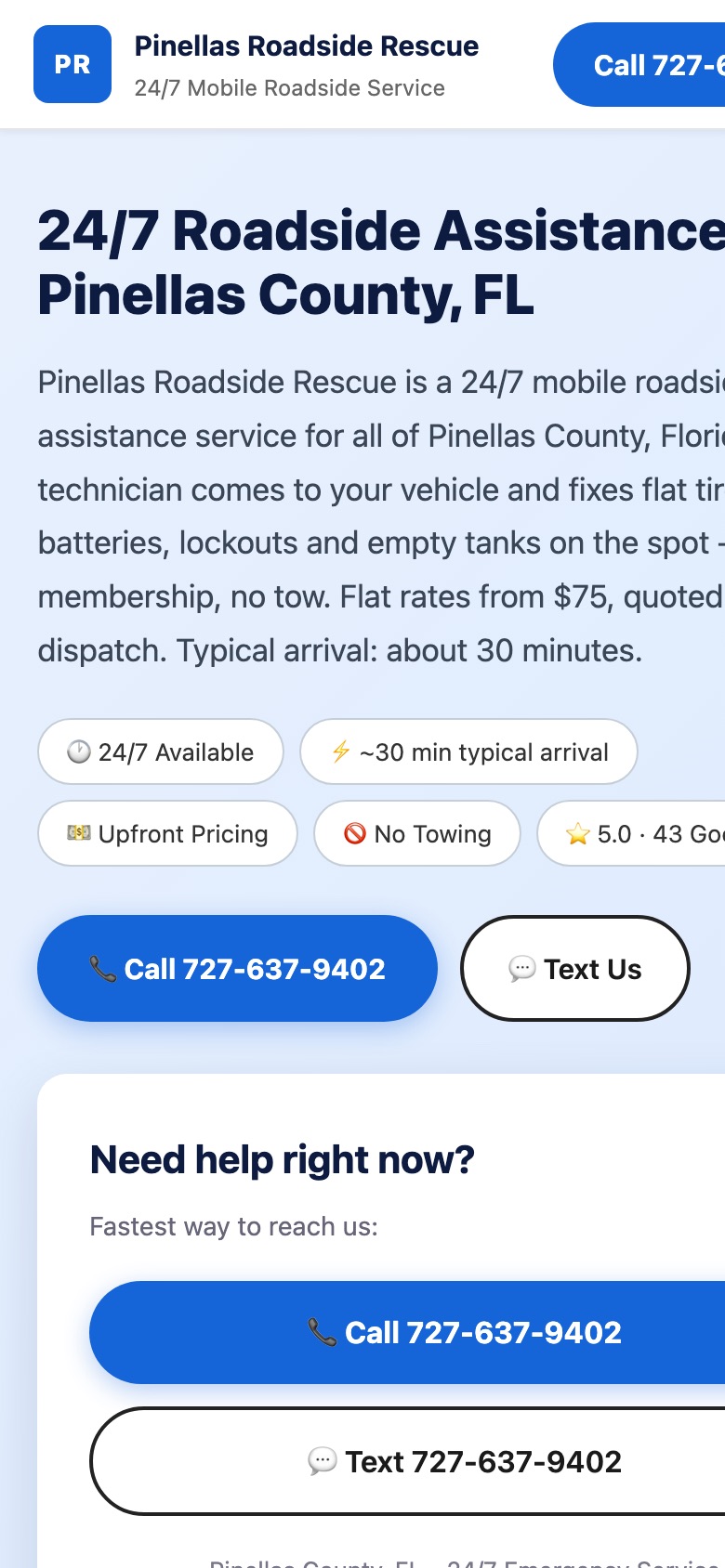
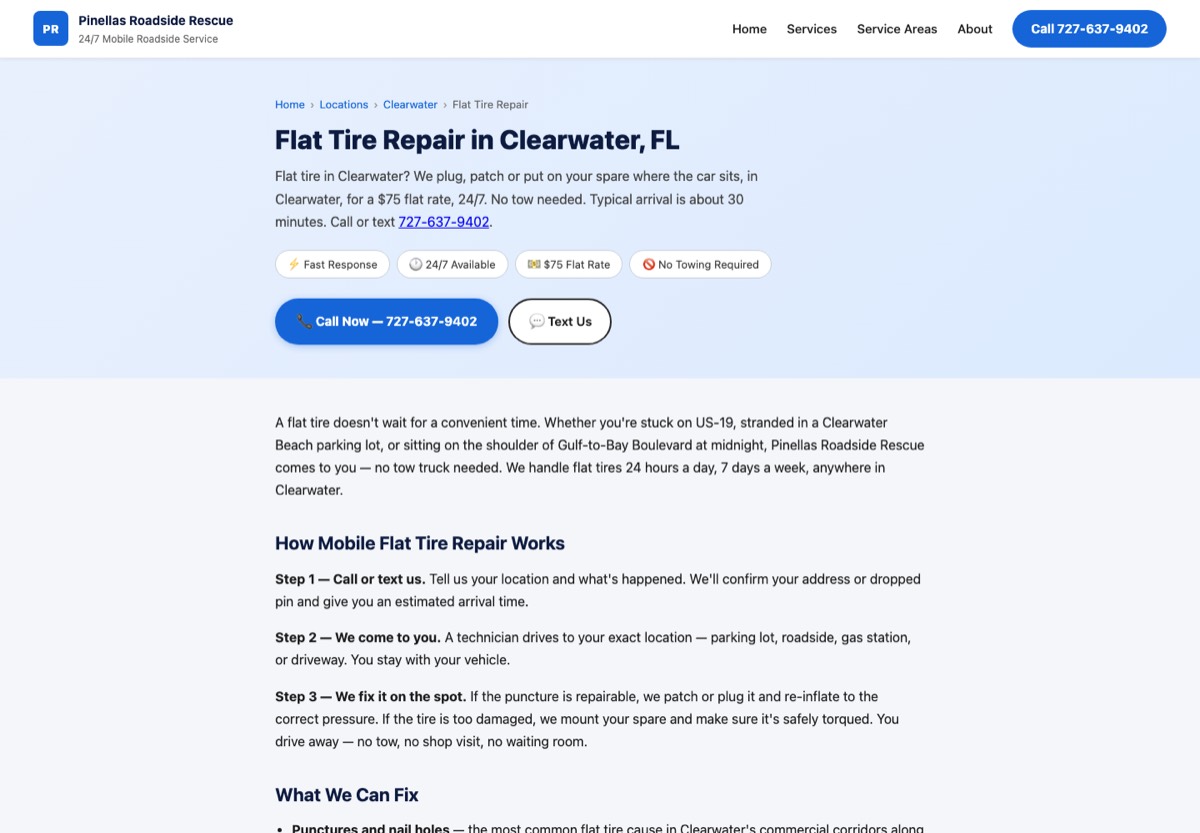
A 90-page roadside assistance website, and the traffic it actually produced between 13 July and 30 October 2026. The business takes around 40 calls in a typical month. Below is what we built, screenshots of the live site, the numbers we measured, the method we used to measure them, and an honest account of how much of that call volume we can and cannot pin on the website.
Pinellas Roadside Rescue is owned and operated by Gary Granzow, the founder of Double G Consulting. It is not a third-party client. We are publishing it as a case study because it is the one project where we control both the website and the books, so we can show the build and the measurement honestly instead of quoting a number a client gave us over the phone.
90 pages, structured so that a search for a specific problem in a specific city lands on a page about that problem in that city.
Flat tire repair, battery jump start, mobile battery replacement, vehicle lockout, emergency fuel delivery and general roadside assistance — each written for Clearwater, Dunedin, East Lake, Gulfport, Largo, Oldsmar, Palm Harbor, Pinellas Park, Safety Harbor, Seminole, St. Petersburg and Tarpon Springs. That is 72 service-area pages plus six service hubs and the supporting pages.
Roadside work is an emergency purchase. Every page leads with a tap-to-call and a tap-to-text button rather than a contact form, because somebody with a flat tire is not going to fill in a form and wait for a reply.
Flat rates are published rather than hidden behind “call for a quote.” This loses the price shoppers early, which is the point — the calls that come through have already accepted the rate.
The services and categories on the Google Business Profile match the services on the site, one to one. The profile is where most roadside customers actually find the business; the site is what they check before dialling.
The call figure is the owner’s count. Everything else is measured from the site’s own logs — real Florida visitors on consumer internet connections, after bots and datacenter traffic are removed. The method is written out below so you can judge it.
The call figure is the owner’s own count across every channel — the Google Business Profile, the website, repeat customers and word of mouth. It is not a website conversion number, and we explain below why we are not presenting it as one.
| Month | Distinct visitors | Page views |
|---|---|---|
| July 2026 (from the 13th) | 10 | 33 |
| August 2026 | 34 | 57 |
| September 2026 | 25 | 45 |
| October 2026 (to the 30th) | 52 | 88 |
| Source | Distinct visitors |
|---|---|
| Direct — typed the address, a saved link, or a Google Maps listing that strips the referrer | 54 |
| Google Search | 36 |
| ChatGPT | 30 |
| Bing | 8 |
| DuckDuckGo | 7 |
| Yahoo | 4 |
| Google Ads | 4 |
The ChatGPT figure is the one worth dwelling on. Roughly a quarter of the people who reached this site in those fifteen weeks were sent by an AI assistant, not by a search engine. Those visits arrive tagged utm_source=chatgpt.com, so they are counted directly rather than inferred. Nineteen of them landed on the homepage and five landed on a city page, which means ChatGPT is citing specific service-area pages and not just the domain.
The service-by-city pages earn their keep. After the homepage, the most-visited pages were mobile battery replacement in St. Petersburg, roadside assistance in St. Petersburg, flat tire repair in St. Petersburg and mobile battery replacement in Largo — all pages that only exist because the site was built city by city.
Most web design case studies end with a revenue figure and an arrow pointing up. Here is what we are deliberately not telling you, and why.
Everything above is checkable. The site is at pinellasroadsiderescue.com and the Google Business Profile, with its review count, is public.
See the same approach applied to roofing, HVAC, plumbing and contracting generally, or browse the rest of our work.
Tell us your trade and your service area and we'll map out the pages your site needs.